

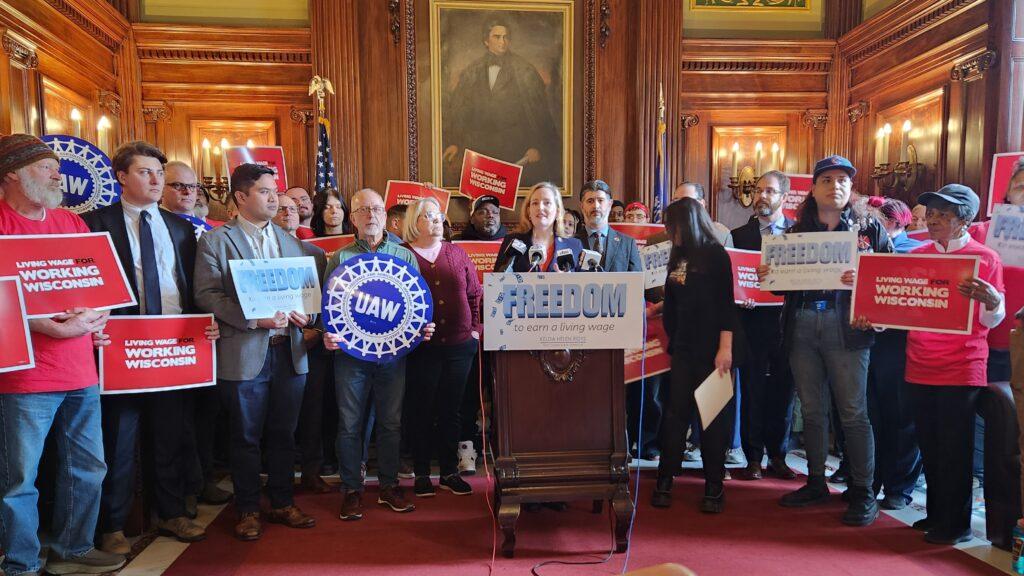


The proposed legislation, announced Tuesday by Sen. Kelda Roys (D-Madison) and Rep. Angelina Cruz (D-Racine), would raise the wage to $15, then ramp up the minimum to $20 in four years and automatically increase the wage thereafter to keep pace with cost of living, the lawmakers said at a press conference in the Wisconsin state Capitol Tuesday.

“I ran for office to make sure working people have a voice in this Capitol,” said Cruz, a first-term member of the Assembly. “This bill is about dignity. It’s about fairness and it’s about building an economy where if you work hard in Wisconsin, you can afford to live in Wisconsin.”
With the Legislature’s current two-year session just about finished, Tuesday’s announcement was also aimed at sending a signal to voters in November about the Democrats’ policy priorities.
“We’re going to continue working for this bill, but even if it doesn’t pass this session, we know that elected officials will be held accountable this fall,” said Roys — who, in addition to being a lawmaker, is one of more than a half-dozen Democrats seeking the party’s nomination to run for governor.
17 years since last increase
The state minimum wage was raised to $7.25 17 years ago, when Roys was a first-term member of the Assembly. The bill aims to make the minimum wage a “living wage” — “the amount of money that a single person needs to earn to cover the basics of their life, housing, utilities, food, transportation and health care,” Roys said.
Based on the numbers produced by the Massachusetts Institute of Technology living wage calculator, “a million Wisconsin workers earn less than a living wage,” she said, adding that even the legislation’s initial boost to $15 an hour is less than a living wage in all 72 Wisconsin counties.
“So, this bill is not only long overdue, it’s actually pretty modest compared to what people actually need to thrive,” Roys said.
The legislation would push the state minimum to $15 per hour on enactment; increase the minimum in stages to $20 per hour by 2030; and index the new minimum to the consumer price index starting in 2030, “so as the cost of living increases, people’s wages will increase with it,” Roys said.
For small businesses with 50 or fewer employees, the $20 wage would be phased in by 2035.
“We believe in supporting workers and respecting the realities facing small businesses,” Cruz said. “Economic justice and small business stability can and must go hand-in-hand.”
The bill would also move the subminimum wage for tipped workers — now $2.33 — to $7.50 immediately and then phase it up to $10 by 2030, after which it would be tied to half the standard minimum wage, Cruz said.
In addition, the bill would repeal a Wisconsin law that currently bars local municipalities from enacting local minimum wage ordinances.
“Communities know their costs, so they should have the freedom to respond,” Cruz said.
‘Backbone of our communities’
About 800,000 Wisconsin workers are paid less than $20 an hour, Cruz said — as “home health care providers, early childhood educators, grocery workers, nursing assistants — the backbone of our communities.”
Wisconsin’s low-wage workers “are essential workers that make our society run,” Roys said. “And nowhere is a living wage more urgently needed than in rural Wisconsin, where many communities have limited employment opportunities. A handful of employers, often massive multinational corporations, can suppress wages because workers have so few alternatives.”
She argued that increasing the minimum wage will strengthen local economies by boosting the average person’s buying power
“Because when a worker in Ladysmith gets a raise, that money’s going to stay in the community in Wisconsin,” Roys said. “But when a national corporation suppresses wages in Ladysmith, those profits go to shareholders in Arkansas or the Cayman Islands. This legislation is an economic development bill for Wisconsin.”
The band of Democratic lawmakers who joined the news conference were outnumbered by a crowd of service workers in red shirts, most of them members of the Milwaukee Area Service and Hospitality Workers union — MASH.
“This bill is about making sure that there’s some more power in the market for workers so we all can make a living wage,” said Troy Brewer, a lead cook at the Fiserv Forum sports arena in Milwaukee and a MASH union steward.

Service workers across the state “are withheld access to economic security, while our jobs continue to act as the backbone to our economy,” said Sabrina Prochaska, a shift leader at Anodyne Coffee in Milwaukee, where the union is negotiating its first contract. “The problem is not our jobs, but rather these jobs do not pay a livable wage. It’s not right and we’re done accepting it.”
The legislation also has the backing of a wide range of unions and allied groups. Many of the same organizations joined with MASH at an event in September to launch their demand for a $20 minimum wage.
Rebuilding the New Deal
Peter Rickman, the president and business agent for MASH, said the legislation is part of a larger mission — to reverse the erosion of the New Deal reforms that were enacted in the 1930s.
Rickman said in that era, a coalition that was led by Democrats but included some Republicans helped build the American middle class by fostering collective bargaining and union rights, and by setting a minimum wage.
The minimum wage was intended as a wage floor that would allow people to make a living, he said.
“It was never intended to be a poverty pay for those folks. It was intended to move the whole labor market. That is how we gave birth to the world’s first middle class,” Rickman said. “We built it with public policy. Politicians took the side of working people and said, ‘We are going to make this labor market work for the working class.’”

He said those policies have been dismantled by “another bipartisan coalition — too many Democrats but mostly Republicans,” which pushed wealth up instead of spreading it among workers.
“The greatest redistribution in the history of the world happened: $79 trillion dollars from worker paychecks went to corporate profits,” Rickman said, citing a Rand Corp. study.
The bill was unveiled days after the Wisconsin Assembly concluded its active lawmaking for the Legislature’s current two-year period. The state Senate is expected to follow suit in a few weeks.
Roys, however, appeared unperturbed by the suggestion that the timing would make its enactment this year unlikely. She noted that the impending wrap-up was the work of the Legislature’s Republican leaders, not a requirement
“Republicans choosing to go home and take a 10-month vacation so that they campaign for re-election is a choice that they are making,” Roys said. “They don’t have to. We could come to work every single day for the rest of the year, just like the workers that are standing up here do.”
She said the session’s end won’t stop proponents from talking up the bill. “Maybe this is the last bill of 2025,” Roys said. “And maybe it’s the first law of 2027.”