

The only time I ever dialed 911 was on the federal government.
I was standing in front of Mueller Park in south Minneapolis holding a beige rifle magazine that contained at least a dozen live bullets. It laid above freshly fallen snow, just a few feet away from the playground.
The magazine had been dropped minutes earlier during a violent confrontation between neighborhood residents and then-Border Patrol Commander Greg Bovino, who was on a PR circuit with a Department of Homeland Security-funded videography team and an entourage of heavily armed agents.
DHS has increased its spending on guns and ammunition dramatically. And much of the weaponry, including the dropped bullets, came from private manufacturers — some local, like the Anoka, Minnesota-based Kinetic Group, which received a $9.92 million government contract in September 2025.
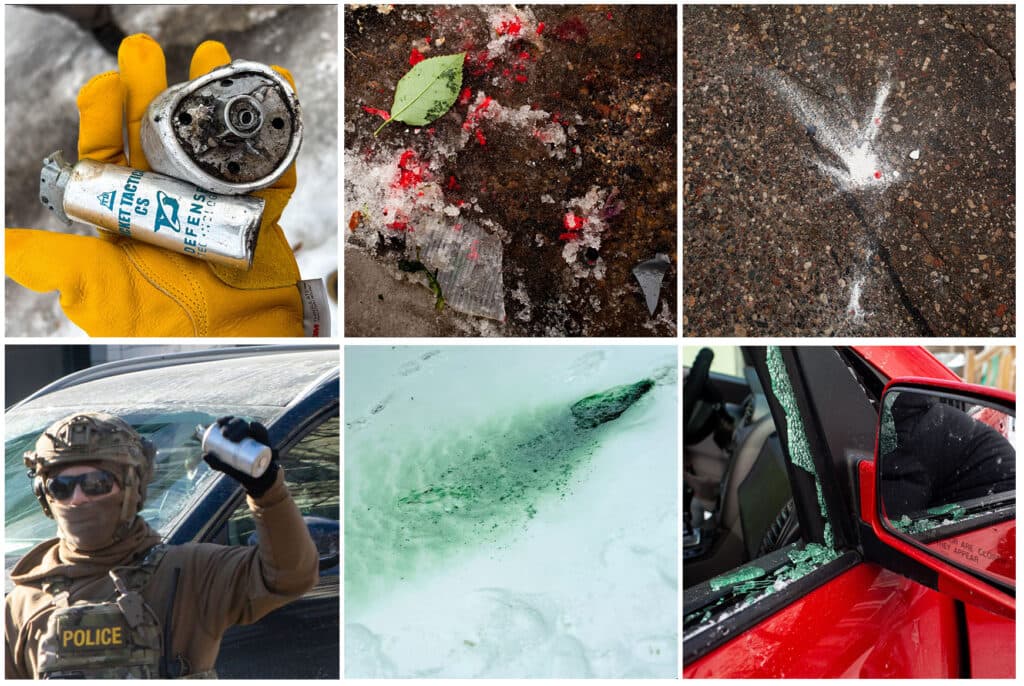
The short propaganda video filmed that day in January depicts Bovino strutting in slo-mo around groups of protesters, some in handcuffs. It does not show agents shoving unarmed, stationary residents to the ground and dragging them through the street. It doesn’t show them indiscriminately pepper spraying, nor does it show Bovino throwing a mysterious green gas onto the park lawn — smoke that eventually seeped back into the feds’ vehicles. They left without making an arrest.
To the left of me, people tended to wounds left by the agents, and to the right were others frantically dousing their eyes with snow and water for relief from the chemicals. Empty school buses were rounding the corner.
I called 911 because students from a nearby elementary school would soon be walking past snowbanks stained orange and green by chemicals, as well as live ammo like the kind used to kill Renee Good and Alex Pretti.
The sour concoction of tear gas and other chemical irritants dissipated as the 911 operator told me an officer would be there to pick up the bullets, amid a “high volume” of callers that day. She apologized in advance for the delay.
I talked to Kat Coats from the neighborhood that day. She submitted details on the incident to the Office of Minnesota Attorney General. “I couldn’t even walk my dogs down my own street because there’s pepper spray in the snow and threatening men carrying guns,” she said.
Although that day was extraordinary, Coats told me Operation Metro Surge changed daily life for her. “You had to shift your routines constantly, like, do I have a gas mask? Do I have a lawyer card?”
Like the Mueller Park fiasco, messy confrontations between agents and observers unfolded across Minnesota during Operation Metro Surge — often resulting in debris littered across neighborhoods.
I did my best to find out more about all the junk left behind by the 3,000 immigration agents. It proved more difficult than you might think.
Bullets in limbo
Sgt. Ryan Kelly, who arrived about 45 minutes after I placed the call, told me the city was holding onto the trash and weaponry found on the streets and believed to belong to ICE.
The Reformer submitted a public records request on Jan. 27 in search of all items left behind by the feds in Minneapolis.
I got almost nothing back; the Minneapolis Police Department wouldn’t initially confirm whether the bullets retrieved from Mueller Park were still in their possession.
Katie Knudsen, a city management analyst, said in an email that MPD wasn’t tracking data tied to ICE litter in “a way that fulfills” my request. When asked if the department could confirm whether the bullets retrieved from Mueller Park are in their possession, Knudsen responded: “Any investigative information that is associated with a police investigation that is still active is not public.”
After nearly two months of processing, the only information I got was a short list of abandoned vehicles — some driven and ditched by agents, others belonging to the people they arrested.
The records show ICE owed the city of Minneapolis impound lot $852 between Jan. 14 and Jan. 15 — the night and morning after agents attacked and shot a Venezuelan man in north Minneapolis — for leaving behind three vehicles. The agency owed the city another $318 for a fourth vehicle found in south Minneapolis on Jan. 23.
Allen Henry, a city spokesman, said the six other vehicles on the list belonged to civilians; two of the vehicles were released to spouses of the owners. One was still impounded as of Jan. 29, the day the data request was submitted. Its release notes say “no keys.”
Even with this little bit of information over a two-week period in January, we can see how abandoned cars of the feds and the people they arrested became part of the urban landscape.
Eventually, in early May — two months after the request was fulfilled and I was told the bullets were in limbo — Henry confirmed the magazine I found in January was inventoried at the MPD Property and Evidence Unit. The feds never responded to pick it up.
He went on to list additional items Public Works collected during the height of the operations.
- Spent smoke and flash grenades
- Various furniture and appliances
- Tires
- Pallets and wood debris
- Paper, wrappers, etc.
No resolution is ‘aggravating’ and ‘wildly exhausting’
In February, Minneapolis estimated the surge had already cost $203 million to the local economy. Minneapolis City Council President Elliot Payne called that figure, which doesn’t encompass the costs of the city’s response, an underestimate.
“We need restitution,” Payne said. “The detritus that they leave around is a reflection of their lack of respect for our people and their values.”
He confirmed multiple instances when agents would leave vehicles running in the middle of the road after arresting the drivers.
The feds “acted with impunity” and “complete carelessness,” he continued, recalling a time where he was assaulted by agents while observing a constituent being “harassed.” A police report was filed but no charges have been pursued.
Payne described the entire operation as “a microcosm” of the disdain the Trump administration has for Minneapolis.
“We’re the site of the murder of George Floyd and one of the most significant modern civil rights movements, and I think they targeted us for that reason alone,” he said.
Coats, the Mueller Park neighbor, called the litter left behind and the inaction on it “aggravating” and “wildly exhausting.”
“I don’t feel like there really has been enough acknowledgement of our continued efforts from our elected people,” she added, pointing to Minneapolis Mayor Jacob Frey.
The Office of Attorney General is looking for information on the objects left behind by Operation Metro Surge. You can fill out a form here.