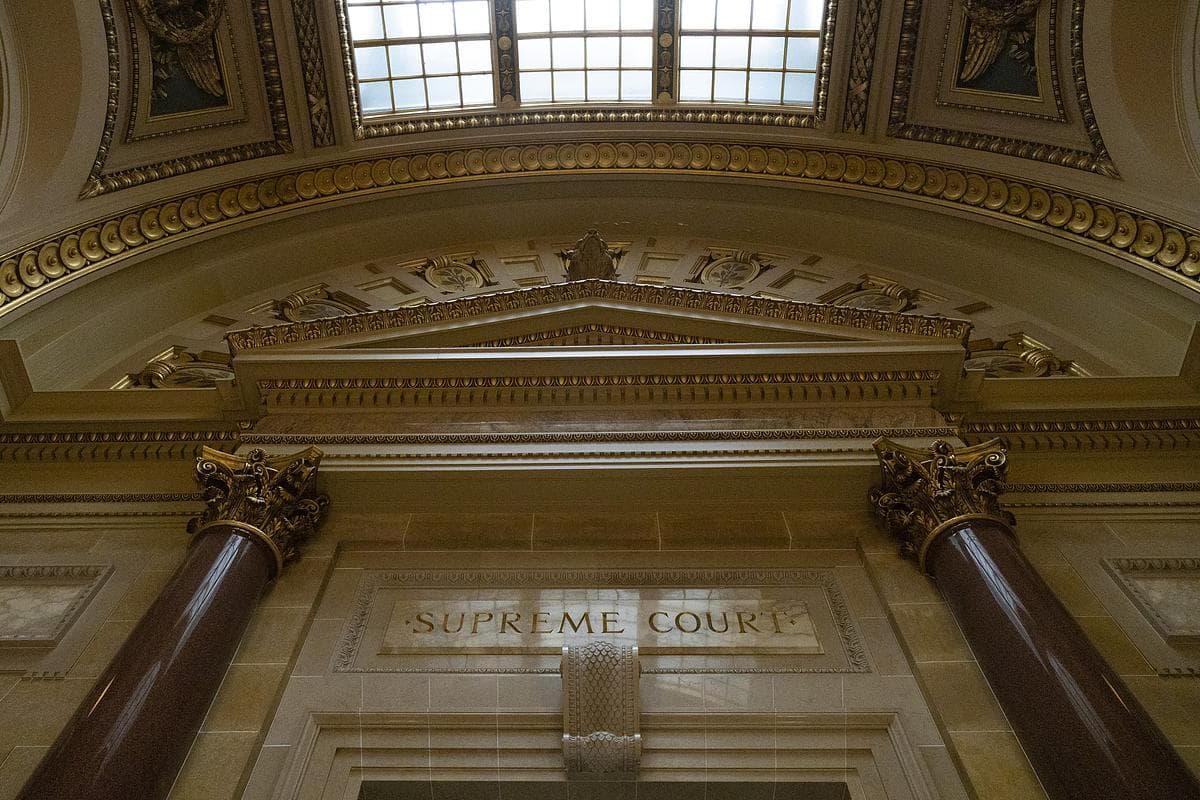


The Wisconsin Supreme Court is scheduled to hear from members of the public this week on a request to require judges to recuse themselves if past donations to or support of their judicial campaign could affect their impartiality in a case.
But it appears unlikely changes to the court’s recusal rules will happen right away.
In letters to the court over the last month, some legal organizations and research groups have argued that the justices should reject the proposal, including the five retired circuit court judges from Dane, Milwaukee and Monroe counties who proposed the changes in the first place.
Instead, the former judges, representatives of Law Forward, the Wisconsin Association for Justice and directors of the State Democracy Research Initiative at the University of Wisconsin-Madison suggest the Wisconsin Supreme Court should establish an advisory committee to study what process would work best in Wisconsin.
The groups said the proposed rule changes before the court on Thursday stem from valid concerns about an impartial judiciary, but could have unintended consequences, such as chilling speech of attorneys who want to participate in elections.
“Having solid judicial recusal standards is very important, and so it seems that the best way to move forward is to pull together a variety of different perspectives to come up with the best solution,” said Rachel Snyder, policy counsel for Law Forward. “More brain power and more thoughtful consideration … could produce a better workable recusal standard that meets the goals of ensuring confidence in the judiciary and ensuring that conflicts are addressed when they need to be, without going too far in the other direction, and chilling speech that we wouldn’t want chilled or opening the door to recusal being something that can then be weaponized.”
The Wisconsin Supreme Court is expected to hold an open conference following the public comment period Thursday morning at the Capitol in Madison to decide next steps, a spokesperson said. The high court could vote on the proposal, decide to form an advisory committee or make other related decisions, the spokesperson said.
Opting for further study would keep the current rules in place ahead of the next state Supreme Court election in 2027. Two candidates already launched campaigns for the April election after Justice Annette Ziegler in March said she would not seek another term on the bench.
Snyder said it’s understandable some people want changes sooner rather than later, but expediency should not supersede reaching the best policy. In the meantime, judges can still voluntarily recuse themselves, she said.
“If we’re going to do it, we should try to get it right to the best of our ability,” Snyder said.
Former Dane County Judge Richard Niess, one of the retired judges who petitioned for the change, said the group had not considered a study committee as a possibility, but thought it was a “terrific” suggestion. To balance concerns about timing for a study, Niess said his colleagues asked the justices to put a deadline on when an advisory committee would share any recommendations.
“We were delighted to receive the responses that we did, all of them, because it was precisely the type of discussion that we want to have, and we want to have it in public, so that whatever is decided upon by the Supreme Court, the public will know what the reasoning is,” Niess said.
Current rules written by business lobby
The debate is part of a decades-long battle over what to do about increasing spending in Wisconsin’s nonpartisan, but increasingly political state Supreme Court races.
“Broadly the question of recusal is important because it gets to the sort of core feature of our judiciary, which is the right to a fair and impartial tribunal,” said Derek Clinger, senior counsel and director of partnerships for the State Democracy Research Initiative, who has studied judicial recusals in and outside of Wisconsin. “That kind of independence and fairness is what gives the courts legitimacy, and so just the fact that the court is considering this shows that they’re taking this issue quite seriously.”
It’s also significant that the court is debating recusal rules given the history of the issue in Wisconsin over the last 15 years, Clinger said.
The rules were crafted after record spending in the 2007 and 2008 Wisconsin Supreme Court elections led to conservative control of the court. State Supreme Court election spending has exploded since then as liberals gained control. The 2025 Wisconsin Supreme Court race drew $144.5 million in spending, topping Wisconsin’s 2023 race as the most expensive high court election in U.S. history.
The former conservative-majority Wisconsin Supreme Court in 2010 adopted the existing rules drafted by Wisconsin Manufacturers and Commerce and the Wisconsin Realtors Association. The rules state judges do not have to recuse from a case because a party or an attorney donated to their political campaigns. WMC did not respond to questions from Wisconsin Watch about whether the rules should change.
The conservative-majority court in 2017 also rejected a petition from 54 retired judges who sought tighter recusal rules.
Nearly a decade later, the five former circuit court judges submitted their petition in January and were granted a hearing in early April. In a memo tied to their petition, the former judges noted that since the 2010 rules were adopted, “the amount of money contributed to Supreme Court elections, and even to some of the state circuit court elections, has exploded.”
“It is not a stretch to conclude some cause and effect relationship,” they wrote.
Niess said he recalled ongoing debates around recusals with Chief Justice Jill Karofsky and Justice Susan Crawford while they were all on the Dane County Circuit Court.
“We were just kind of shaking our heads about how did we get to this point,” Niess recalled. “And since … these two individuals have joined as justices, it seemed the perfect time for us to just serve up a petition to get a discussion going.”
At a WisPolitics event in October, Karofsky committed to holding a public hearing about establishing a recusal rule for the court.
“We need to bring people into the Supreme Court hearing room and we need to hear about what kind of rule and what kind of parameters on a rule people think that we should have,” Karofsky said at the time.